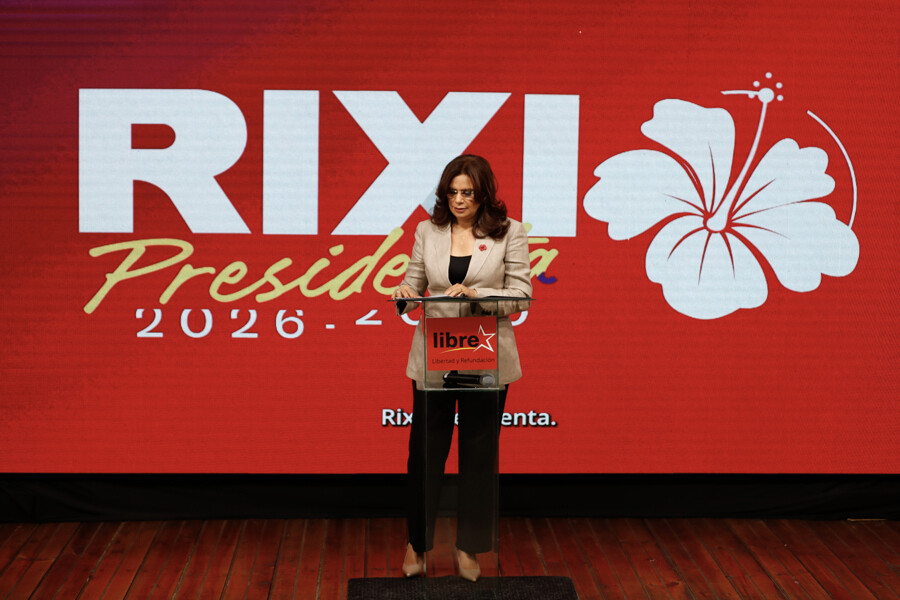
The ruling party's presidential candidate in Honduras, Rixi Moncada, denounced on Saturday actions of 'interference' by U.S. President Donald Trump in the general elections this Sunday. At a press conference, Moncada stated that Trump's Friday announcement that he will pardon former President Juan Orlando Hernández, who is serving a 45-year prison sentence for drug trafficking, is 'a crime' and aims to 'reintroduce organized crime' into Honduran politics. Moncada affirmed that 'there is no doubt' that 'two concrete actions were registered three days before the elections, which are totally interfering,' in reference to Trump's public support for conservative candidate Nasry Asfura and the pardon announcement for Hernández. She added that Trump's messages are 'two campaign acts' in favor of what she called his 'puppet candidates' from the National and Liberal parties, Nasry Asfura and Salvador Nasralla, respectively. Despite her criticisms, the official candidate assured that Honduras maintains a 'good relationship' with the United States. On Wednesday, Trump asked Hondurans to vote for Asfura and accused his opponents of representing the 'advance of communism' and being allies of leaders like Venezuelan Nicolás Maduro. He also stated that Moncada is 'close to communism' and that Nasralla seeks to 'deceive the people' to split the vote. Moncada maintained that Honduras, like other countries in the region, has been the object of a 'siege' from persistent 'interventionist' policies and actions that date back to the colonial era and continue to the present day. 'Interventionist policies, those of capital over the lives of human beings and their territories, are there,' she affirmed, and warned that such practices 'have not stopped' and she will continue to 'combat them.' Moncada described Hernández as 'the biggest capo in the history of Honduras' and 'the main representative of the bipartisanship,' and stated that during his mandate, '400 tons of cocaine' would have been sent to the United States, leaving a 'trail of murders, corruption and 57 convicted' linked to his administration in U.S. courts. 'Bipartisanship turned Honduras into a tax haven, money launderers, corrupt and corruptors, tax evaders (…), organized crime,' she expressed, and assured that the arrival of Xiomara Castro to power and the resistance movement have managed to curb that dynamic. Moncada called on the citizenry to vote 'with hope' and to prevent the return of 'narcotic activity' and 'the infamous bipartisanship.'