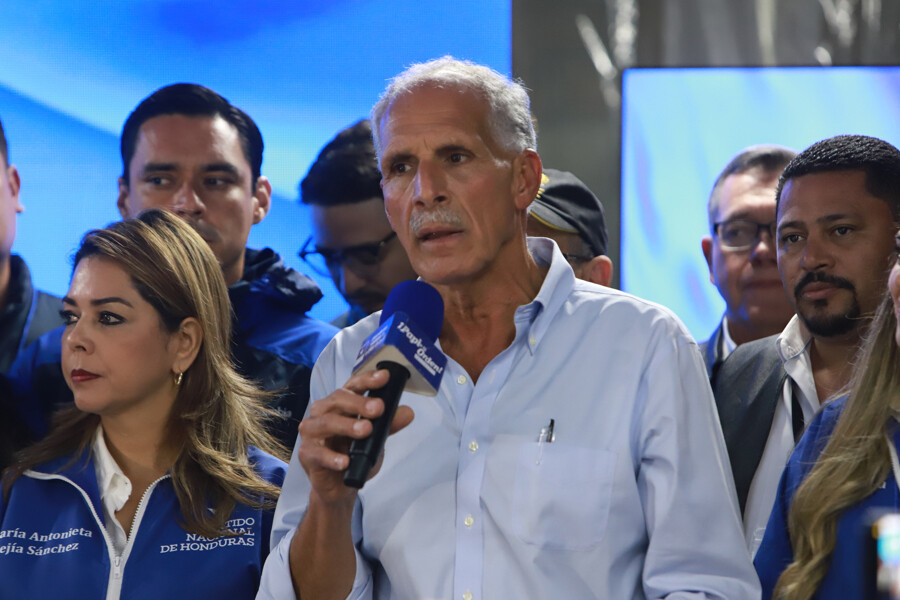
The presidential candidate for Honduras' conservative National Party, Nasry Asfura, backed by U.S. President Donald Trump, is leading the results from the November 30 general elections. As the first phase of the count nears completion, he has widened his lead over Salvador Nasralla of the Liberal Party. With 98.77% of the tallied sheets, Asfura leads with 1,291,320 votes (40.53%), while Nasralla (both conservatives) has received 1,247,554 ballots (39.16%). According to records from the National Electoral Council (CNE) until 21:00 local time (03:00 GMT), the officialist candidate from the Liberty and Refoundation Party (Libre, left), Rixi Moncada, is in third place with 615,712 votes (19.32%). In the first phase of the count, which is about to finish, Asfura leads Nasralla by 43,766 votes, double the margin recorded twelve hours earlier. The tally, which has had several interruptions—the last for three days—will continue with more than 2,750 ballots with inconsistencies, which will be added to the 16,178 correct ones registered on the electoral body's website. The inconsistent ballots, which could exceed 500,000 votes, will go to a special tally that could begin Tuesday or Wednesday with the presence of political party representatives, the CNE, national and international observers; the auditing firm of the electoral process, and prosecutors. The special tally will be held in two daily shifts of twelve hours each. Former Supreme Electoral Tribunal (TSE) magistrate Augusto Aguilar told EFE that the CNE's results remain preliminary until the review of the irregular ballots is completed. Aguilar expects the special tally, which will cover ballots with digitization errors, numerical inconsistencies, or incidents reported at the polling stations, to begin this Tuesday under the supervision of political parties, international missions, and national watchers. During this phase, which could last between two and three days, the electoral body will verify the 'ballots with irregularities,' and 'when the numbers don't add up, there are more voters than votes, or there are errors in the sums, a new act will be drawn up that will be valid,' Aguilar explained. The final result will be declared once that review is finished, which could confirm the current trend or 'change' the preliminary results, specified the former TSE magistrate. Nasralla said on social media that he will be the next president of Honduras and will take office on January 27, 2026, and that the difference in favor of Asfura will be reversed with the special tally. Additionally, he accused the National Party of 'inflating ballots' to show that it had more votes in many communities where the population would have voted for the Liberal Party. Carlos Flores, one of Asfura's presidential designate (vice president) candidates, told a Televicentro Corporation channel that they have an accounting of 100% of the electoral ballots, both digital and physical, that the other candidates who participated in the contest should also have, which confirm the 'triumph of the National Party.' He added that according to the records they have so far, the National Party has won in 202 municipalities (out of 298 in the country) in 12 of the 18 departments of the national geography. Furthermore, according to Flores, his party won 50 of the 128 deputies in Parliament, against 40 for the Liberal Party led by Nasralla. Since the November 30 elections, the CNE has a 30-day deadline to officially announce the results, which will confirm the vote of the Hondurans for a new president, three presidential designates (vice presidents), 298 mayoralties, 128 deputies for the local Parliament, and 20 for the Central American one.