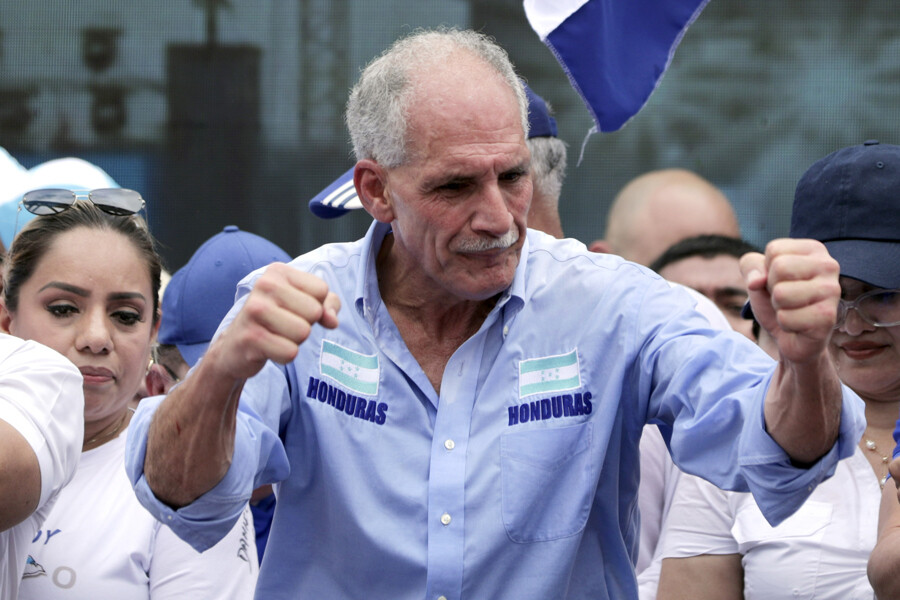
The presidential candidate for Honduras' conservative National Party, Nasry 'Tito' Asfura, continues to lead the results of the general elections held on November 30 with 40.31% of the vote, according to data from the Supreme Electoral Council (CNE). Asfura is still ahead as over 1,000 of the 2,792 ballot papers with inconsistencies remain to be recounted. A special recount, which began on Thursday, has navigated a series of obstacles put up by politicians from the three major parties: National, Liberal (also conservative), and Freedom and Refoundation (Libre, left-wing). The special recount, which was paralyzed for about twelve hours between this Saturday and Sunday, continues with a slow, against-the-clock count. The special recount, which was supposed to start on December 13, began five days late amid an atmosphere of uncertainty and suspicion, as well as allegations of supposed 'fraud' by presidential candidates from the Liberal Party, Salvador Nasralla, and Rixi Moncada from the ruling Libre party. As of 20:30 local time (02:30 GMT) today, and after the Supreme Electoral Council's (CNE) website resumed vote counting, Asfura, who is supported by U.S. President Donald Trump, was leading with 1,381,675 votes (40.31%), followed by Nasralla with 1,355,598 votes (39.55%). Moncada remains in third place with 655,898 ballots (19.13%), with 99.88% of the ballot papers having been recounted. Before the twelve-hour paralysis of the count, which began on Saturday night, CNE authorities' projections were that the final results would be ready between Monday and Tuesday. The deadline for results is December 30. In addition to the technical and administrative problems the CNE has faced, there have been threats, insults, and other abuses from Libre party councilor Marlon Ochoa, denounced by councilors Ana Paola Hall, president of the body, and Cossette López, who represent the Liberal and National parties, respectively. Since the day Hondurans went out to vote en masse, peacefully, and in order, according to reports from national and international observers, the CNE has until December 30 to announce the official results of the elections, so the urgency of the special recount is clear. If there are no official results by December 30, the problem would move to the National Congress, whose president, Luis Redondo — a member of the ruling party — has not called for plenary sessions since the end of August, and who in October installed a Permanent Commission, made up of only nine deputies out of the 128 that make up that branch of state. Although the Permanent Commission has broad powers, the issue of electoral results would correspond to the plenary session of the deputies, who would have to be convened. Marked differences in the legislature led in October to more than 70 deputies, mostly from the Liberal and National parties, to set up a parallel parliament, which has been holding sessions and does not recognize the Permanent Commission created by Redondo with ruling party members. The general elections last November were the twelfth since Honduras returned to constitutional order in 1980, and the most difficult in the country's Central American political history, according to the CNE. Hondurans voted to choose the successor to the current president of the country, Xiomara Castro, whose husband is former President Manuel Zelaya (2006-2009), who is also her main advisor and general coordinator of the Libre party. They also voted for three presidential designees and municipal and legislative authorities.